Concrete Pumping: When a Pump Truck Is Worth the Cost
By Daniel Reyes · Published · 5 min read
A pump truck is one of those line items that surprises homeowners: the concrete itself might cost $700, and the machine that places it can add several hundred to a couple thousand dollars on top. Whether that money is well spent depends almost entirely on how far the truck can get from the pour and how much hand labor you would otherwise pay for.
This guide covers how pump pricing actually works, the difference between line pumps and boom pumps, and the site conditions that flip a pump from luxury to necessity. Numbers here are typical Southwest Florida ranges for planning; get local quotes before you budget.
How Pump Pricing Actually Works
Pumping is billed in layers, not as a single flat fee. Expect a mobilization or setup charge to get the rig to your address, a minimum charge that covers roughly the first couple of hours on site, and an hourly rate after that. Most residential pours fall in the $500 to $1,500 range all-in, but a small slab that takes 30 minutes to place may still hit the minimum.
There is also a pump fee charged per cubic yard on some jobs, and a washout or cleanup charge. Ask for the minimum hours, the hourly rate after that, and whether travel time is billed. On a tight lot where the truck sits for two hours because the finishers are slow, the hourly clock matters more than the concrete price.
One practical note: many suppliers and pump operators will quote a "cash price" for the concrete plus a separate pump invoice. Get both in writing before the day of the pour so nobody is negotiating while 10 yards of concrete sits in a drum.
- Mobilization/setup fee: typically $150–$400
- Minimum charge: often covers 1.5–2 hours on site
- Hourly rate after minimum: roughly $150–$250/hour
- Per-yard pump fee: some operators charge $10–$25/yd
Line Pump vs Boom Pump: What You Are Paying For
A line pump pushes concrete through 2- to 3-inch steel pipe laid on the ground, and it can snake around a house, through a gate, or up a slope to reach a backyard slab. It is the cheaper option, generally several hundred dollars less than a boom, and it works well for patios, driveways, and additions where the hose run stays under about 150 feet.
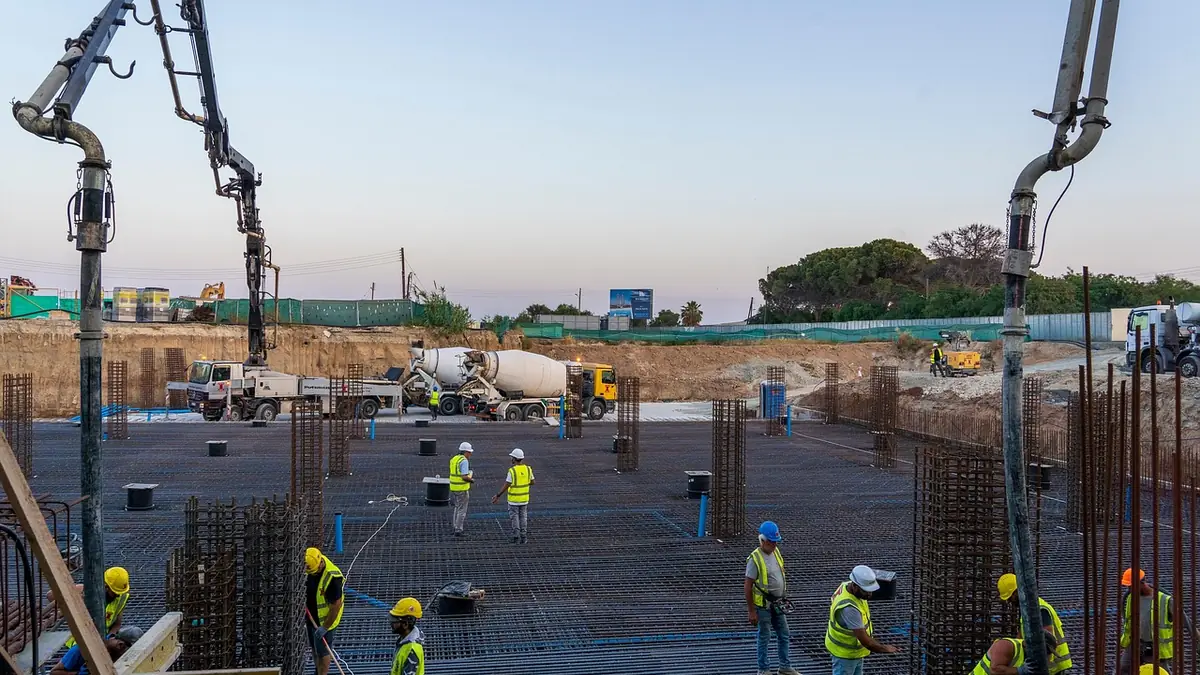
A boom pump carries an articulated arm that unfolds over fences, pools, and roofs, placing concrete directly where it is needed without dragging hose. Boom trucks cost more and need room to set up outriggers, but they shine on tight lots, second-story decks, and pool decks where a hose run would cross finished landscaping.
The deciding question is simple: can a hose physically reach the pour point without crossing something you cannot damage? If yes, a line pump is usually enough. If the answer requires lifting concrete over a structure, price the boom.
When Pumping Saves You Money
Pumping earns its keep when the alternative is wheelbarrows. If the pour is more than about 60 to 80 feet from where the truck can park, or if the path involves grass, a slope, or a narrow gate, hand-barrowing a few yards becomes hours of labor and a lot of spilled mud. Crews typically charge $50 to $100 per hour per laborer, so three helpers for a long morning can approach the pump fee.
Pumping also protects quality. Concrete placed quickly stays workable, which matters in Florida heat where a mix can stiffen within 30 to 45 minutes. Fast placement means fewer cold joints and a better finish, especially on larger slabs. If your pour is over about 5 cubic yards and the access is awkward, the pump often pays for itself in labor and finish quality.
Finally, consider the cost of damage. Dragging wheelbarrows across new sod, irrigation lines, or a paver walkway can cost more to repair than the pump itself.
- Hose run over ~60 feet from the truck
- Pour over ~5 cubic yards with limited access
- Sloped or soft ground that wheelbarrows cannot cross
- Finished landscaping or irrigation in the path
When You Can Skip the Pump
For a straightforward driveway, sidewalk, or front-yard pad where the chute reaches the forms, the truck's own chute is free and fast. Standard rear-discharge trucks reach roughly 16 to 18 feet from the rear axle, and chute extensions add a few more feet. If that gets concrete into the forms, do not pay for anything else.
Small pours under 2 or 3 cubic yards are usually cheaper to mix on site or haul by hand than to mobilize a pump. The same goes for jobs where a short hose run and a couple of wheelbarrows cover it in under an hour. If you are repairing a section rather than pouring new, see How to Fix Cracks in a Concrete Driveway for approaches that rarely need a pump.
A middle option is a towable or trailer-mounted line pump, which some operators rent with an experienced operator. It is cheaper to mobilize than a full truck but still needs a clear hose path and a water source for cleanup.
Site Prep and Access Rules That Affect Price
Pump operators care about three things: where the truck can park, where the outriggers go, and where the washout water goes. A boom truck needs a firm, level pad roughly 20 by 30 feet, clear of power lines and septic drain fields. Soft Florida fill or a lawn after rain can force the operator to refuse the setup, and you may still owe the mobilization fee.
Line pump hose needs a clear path at least a few feet wide, with no sharp bends that cause blockages. Tell the operator about gates, fences, pool screens, and low branches in advance. Washout is another line item: the slurry cannot go down a storm drain, so plan a lined washout pit or pay the operator to haul it away.
If your project involves steps or elevated landings, coordinate the pump schedule with the formwork. Our guide to concrete stair and step construction explains why stair pours often go faster with a line pump and a small crew.
| Pump type | Best for | Typical setup/mobilization | Hourly or minimum | Typical total for a small job |
|---|---|---|---|---|
| Truck chute only | Front-yard pours within ~16–18 ft of truck | $0 | $0 | $0 |
| Trailer/line pump (rental with operator) | Backyards, hose runs under ~150 ft | $150–$350 | $100–$175/hr | $400–$900 |
| Truck-mounted line pump | Long or winding hose runs, larger slabs | $200–$450 | $150–$250/hr, 1.5–2 hr minimum | $600–$1,300 |
| Boom pump | Tight lots, over structures, pool decks | $300–$600 | $175–$300/hr, 2 hr minimum | $900–$1,800 |
Budgeting the Whole Pour, Not Just the Concrete
Pumping is one line among several. A typical residential project budget includes the concrete mix, the pump, labor for placing and finishing, rebar or mesh, forms, and sometimes a short-load fee if the order is under about 5 cubic yards. Comparing pump quotes without the rest of the numbers can lead to false savings.
For a full breakdown by project type, our concrete patio cost guide for Southwest Florida homes shows how placement method changes the total. And remember that curing in Florida heat is its own schedule: how long concrete takes to cure in Florida heat affects when you can strip forms, park on the slab, or build on it.
- Short-load fees often apply under ~5 cubic yards
- Washout and cleanup may be billed separately
- Saturday or early-morning pours can carry premiums
- Get the pump and concrete quotes on the same day
- Pumping usually pays off when the pour is more than ~60 feet from the truck or access is awkward.
- Line pumps are cheaper and handle most backyard pours; boom pumps cost more but reach over obstacles.
- Ask about minimum hours, mobilization, per-yard fees, and washout before the day of the pour.
- Skip the pump when the truck chute reaches the forms or the pour is under 2–3 cubic yards.
Daniel has spent years writing about concrete construction, repair, and finishing for homeowners in the Sarasota area. He focuses on practical cost guides and clear explanations so readers can plan projects with confidence. His work covers driveways, patios, foundations, and decorative concrete finishes.